
Aloe vera gel is light, clear and mostly water. It feels cool and sinks in fast, but leaves little behind. Aloe vera cream blends aloe with water and oils into a thicker, smooth emulsion that keeps skin feeling moisturized for longer. Gel suits a quick, cool feel; cream suits everyday moisture, especially on dry skin.
The short version
| Aloe vera gel | Aloe vera cream | |
|---|---|---|
| Texture | Light, clear, often water-based1 | Thicker, smooth, opaque1 |
| Main base | Mostly water | Water plus oils1 |
| How it feels after | Cool and quick, with little left behind | Soft and moisturized; non-greasy creams exist |
| Typically chosen for | Oily skin, a cool feel after a day outdoors | Dry or rough skin, hands, heels, elbows, face and body |
| How often | Whenever you want the cool feel | A few times a day, and right after washing2 |
| Good to know | Check where aloe sits on the label | Check where aloe sits on the label6 |
What is aloe vera gel?
Plant gel and bottled gel
Aloe products can be made from different parts of the aloe leaf, including the clear gel from the inner leaf.5 That's the gel you see when you cut a leaf open.
A bottled aloe gel is a product made from aloe. Read its label to see what else is in the bottle and where aloe sits on the list.
How gel feels
Gel goes on cool and light. It disappears into the skin quickly, which makes it feel good on a warm day or after time outdoors.
Because it's mostly water, gel doesn't leave much on the skin once it dries. Some people find their skin wants more moisture soon after.
What is an aloe vera cream?
Water and oil, held together
A cream is an emulsion: water and oils blended so they stay mixed. That's what gives a cream its body.
Moisturizers work in a few ways. Humectants draw water into the skin and hold it there. Emollients soften and smooth the skin's surface. Occlusives form a film that slows moisture loss.3 Moisturizers, creams included, often combine these.4
An aloe cream adds aloe vera to that mix, so you get the aloe and the oils in one step.
What "aloe first" means
US cosmetic labels list ingredients in descending order of predominance.6 When aloe vera is the first ingredient, there's more aloe in the jar than anything else.
On a label, aloe vera usually reads "aloe barbadensis leaf juice". If it's near the end of the list, the cream has only a little.
How to tell them apart on the shelf
- Look. A gel is usually clear or slightly green. A cream is opaque and white or off-white.
- Name. Labels usually say "gel", "lotion" or "cream". Trust the word on the label more than the picture on the front.
- Feel. Rub a little between your fingers. A gel turns watery and vanishes. A cream spreads smoothly and leaves skin feeling soft.
- Label. Turn it over and find aloe vera, listed as "aloe barbadensis leaf juice". The closer it is to the top, the more aloe there is.6
Cream vs gel: when people choose each
People often reach for gel when they want:
- Something light for oily skin. Dermatologists say a gel, which is lighter, can suit oily skin.1
- A cool feel after a day outdoors.
- A thin layer under makeup.
People often reach for cream when they want:
- Moisture for dry or rough skin.
- Something for hands that get washed all day.
- A thicker layer for heels and elbows.
- A winter moisturizer.
- A daily moisturizer as skin gets older. Dermatologists suggest everyone 50 and older use a cream-based moisturizer.1
If your skin is very dry, read why very dry skin does better with an aloe cream. It goes deeper on that one question.
What about aloe lotion?
A lotion sits between a gel and a cream. It's thinner than a cream, with less oil.1
For dry skin, dermatologists suggest a cream or an ointment rather than a lotion.2
Can you use aloe gel and cream together?
Yes. If you like the cool feel of gel, smooth it on first and let it sink in. Then follow with a cream to keep skin feeling moisturized.
Keep it simple. Two thin layers are easier to manage than one heavy one.
Can you use aloe vera cream on your face?
Yes. An aloe cream works as an everyday face moisturizer, morning and night.
If your skin is oily, a lighter gel may suit your face better.1 With any new product, try a small patch first.
Where Corium 21 fits
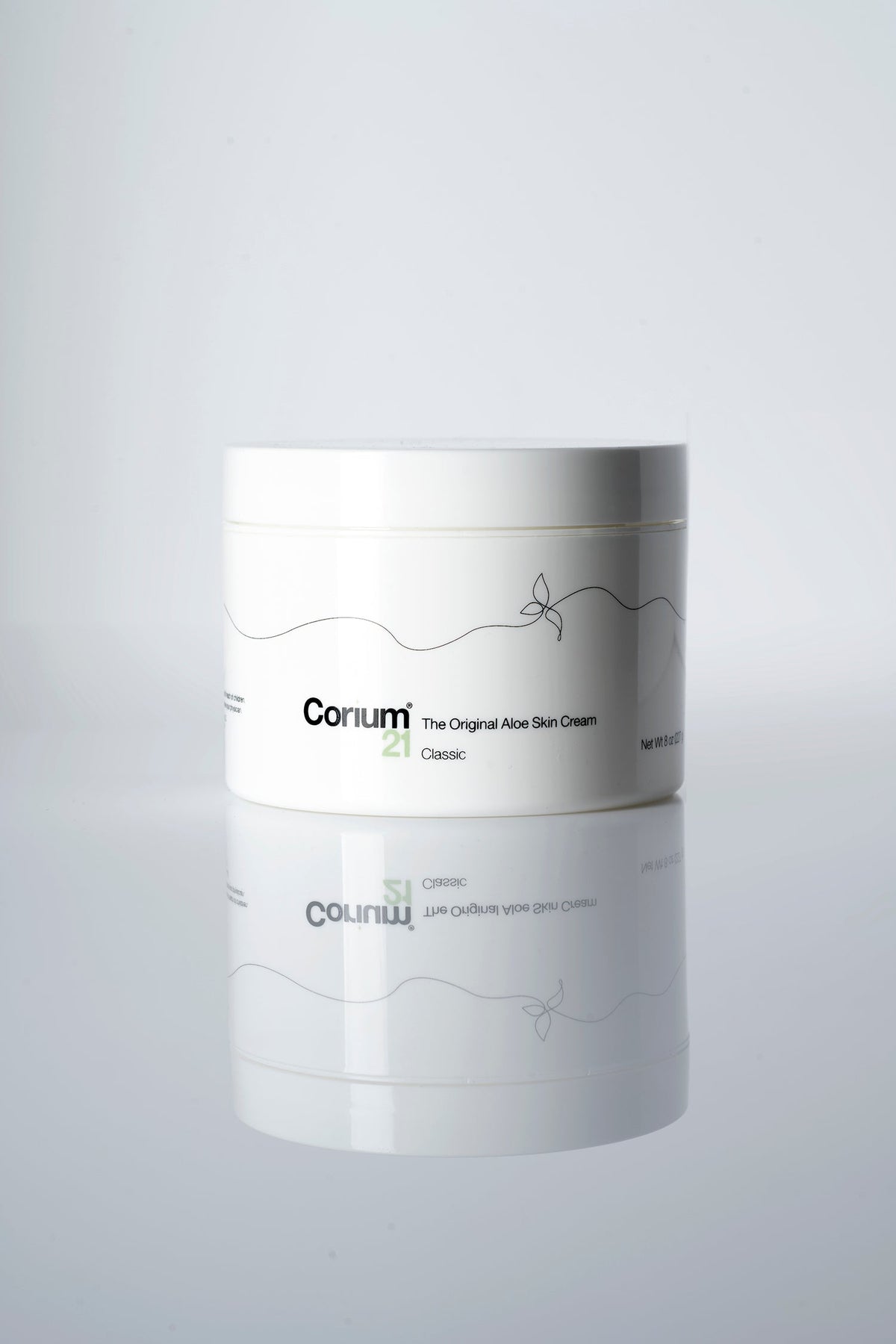
We make Corium 21. It's a cream, not a gel: rich, smooth and non-greasy, with certified organic aloe vera as its first ingredient.
Along with the aloe, it has vitamins A, B3 and E, soluble collagen, plant oils, and green tea, chamomile and ginseng extracts. See every ingredient.
It comes in Classic Fragrance and Fragrance Free, the same formula without the fragrance. People use it on face and body too.
Our customers tell us they just use a dab. A little bit goes a long way. An 8-oz jar is typically a 4-6 month supply of daily use.
Try the Free Samples (one jar of each scent) or shop the 8 oz jar. Trusted since 1994. Family-owned in Oregon.
Questions people ask
Is aloe vera cream or gel better?
It depends on your skin. Aloe vera gel is lighter and suits oily skin or a quick, cool feel. Aloe vera cream is thicker and more hydrating, so it usually suits dry skin.1
What's the difference between aloe vera gel and cream?
Aloe vera gel is mostly water and feels light and cool. Aloe vera cream blends aloe with water and oils, so it's thicker and keeps skin feeling moisturized longer.
Can I use aloe vera cream on my face?
Yes. Aloe vera cream works as a daily face moisturizer. If your skin is oily, a lighter gel may suit you better, and it's wise to try any new product on a small patch first.
Is aloe vera gel enough for dry skin?
On its own, aloe vera gel feels light and leaves little behind. Dry skin usually feels better with a cream, which carries more oil.1
Is aloe vera lotion the same as aloe vera cream?
No. An aloe lotion is thinner and has less oil than an aloe cream.1
Is Corium 21 a gel or a cream?
Corium 21 is a cream. It's rich and smooth, goes on easily and leaves a non-greasy finish.
Can I use aloe gel and aloe cream together?
Yes. Put the gel on first for the cool feel, let it sink in, then follow with the cream.
More to read
- How to choose an aloe vera cream for dry skin
- Aloe vera cream vs petroleum jelly
- Aloe cream for very dry skin
- Dry hands, dry heels and your face
- Our Promise
Sources
-
American Academy of Dermatology, How to pick the right moisturizer for your skin, https://www.aad.org/public/everyday-care/skin-care-basics/dry/pick-moisturizer.
-
American Academy of Dermatology, Dermatologists' top tips for dry skin, https://www.aad.org/public/everyday-care/skin-care-basics/dry/dermatologists-tips-relieve-dry-skin.
-
Cleveland Clinic, Emollients, https://my.clevelandclinic.org/health/treatments/23305-emollients.
-
DermNet, Emollients and moisturisers, https://dermnetnz.org/topics/emollients-and-moisturisers.
-
National Center for Complementary and Integrative Health, Aloe Vera, https://www.nccih.nih.gov/health/aloe-vera.
-
FDA, Cosmetics Labeling Guide, https://www.fda.gov/cosmetics/cosmetics-labeling-regulations/cosmetics-labeling-guide.