
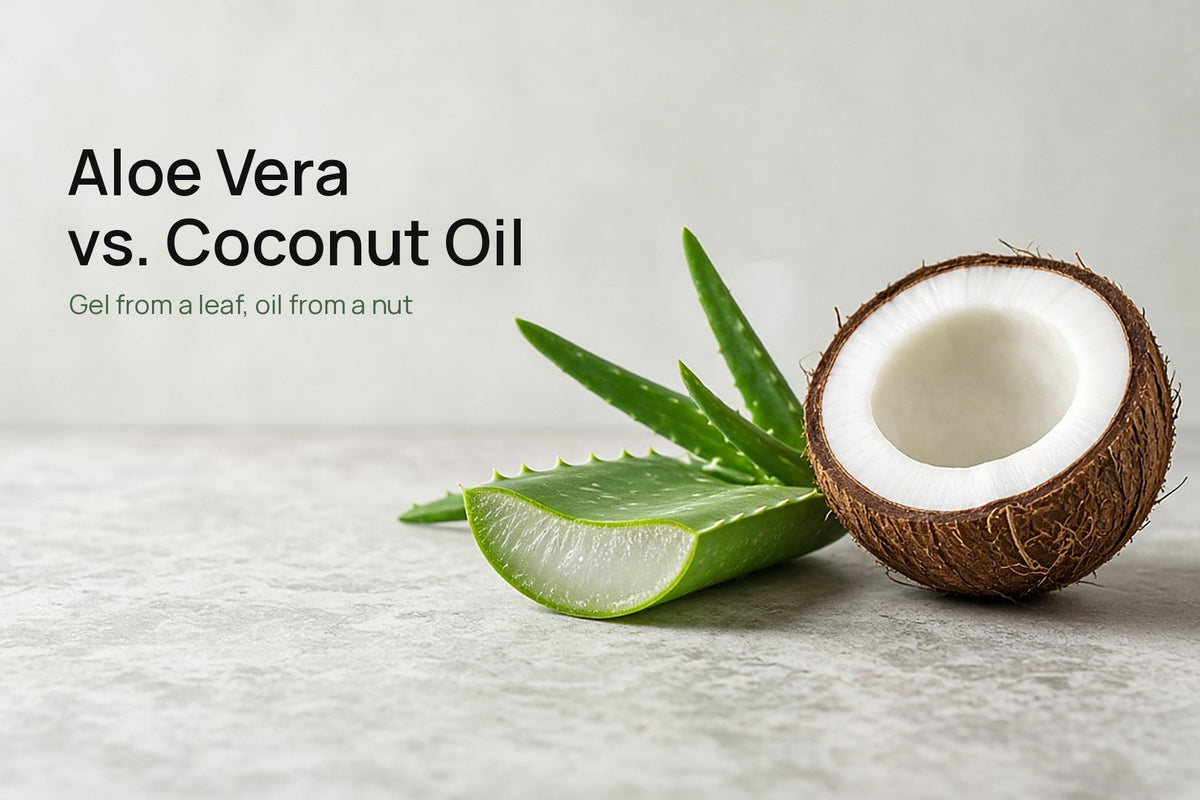
Last updated: October 2026
Short answer: Aloe vera gel is about 99.5% water and works as a humectant that helps skin hold water. Coconut oil is an oil, so it softens skin and slows water loss. In a randomized, double-blind trial, virgin coconut oil worked as well as mineral oil for mild to moderate dry skin. For very dry skin, use aloe first and an oil or cream on top, or a cream that contains both kinds of ingredient.
At a glance
| Aloe vera | Coconut oil | |
|---|---|---|
| Type | Humectant (water-based gel) | Emollient (oil) |
| Feel | Light, cool, absorbs fast | Greasy at first; solid in a cool room |
| Research on dry skin | Improved hydration; didn't change water loss on its own | As effective and safe as mineral oil for mild to moderate dry skin |
| Best for | Face, hands, warm weather, after sun | Body, legs, feet, cuticles |
| Watch out for | Occasional burning, itching or rash | Can feel heavy on the face |
| On a label | Aloe Barbadensis Leaf Juice | Cocos Nucifera (Coconut) Oil |
What aloe vera does
Aloe gel is about 99.5% water, plus polysaccharides that help hold it. Reviews of the research found aloe products improved skin hydration, likely as a humectant, but didn't change how much water escaped. In one study, creams with 0.1% to 0.5% aloe extract applied for two weeks increased skin hydration. The NIH says topical aloe gel is generally well tolerated.
What coconut oil does
In a randomized, double-blind trial in people with mild to moderate dry skin (xerosis), extra virgin coconut oil and mineral oil had comparable effects: both significantly improved skin hydration and raised skin surface lipids (fats and oils), with no safety concerns. The authors concluded coconut oil is as effective and safe as mineral oil as a moisturizer.
In a separate study of 117 children with mild to moderate atopic dermatitis (eczema), reported at the American Contact Dermatitis Society meeting, 93% of the virgin coconut oil group improved, compared with 53% on mineral oil, after 8 weeks of twice-daily use.
Which is better for dry skin?
Coconut oil has the stronger evidence as a stand-alone moisturizer for dry skin on the body. Aloe is lighter and better suited to the face, hands you need to use right away, and warm weather. Since aloe adds water and oil helps hold it in, they work well together. A dermatology review found humectants relieve dryness better when combined with occlusives (ingredients that seal water in).
Coconut oil can feel heavy on the face. If you're prone to breakouts, try it on a small area first.
How to find them on a label
Aloe is "Aloe Barbadensis Leaf Juice." Coconut oil is "Cocos Nucifera (Coconut) Oil," and coconut-derived ingredients such as caprylic/capric triglyceride and coco-glucoside are different ingredients that behave differently. The Ingredient Label Decoder explains what each ingredient does.
Check your own moisturizer. Paste its ingredient list into our free Ingredient Label Decoder to find the likely 1% line, see a rough percentage for each ingredient, and learn what each one does.
Frequently asked questions
Is aloe vera or coconut oil better for dry skin?
For dry skin on the body, coconut oil has stronger evidence: a randomized trial found it as effective and safe as mineral oil. Aloe vera is lighter and helps skin hold water. Many people use aloe first and an oil or cream on top.
Can I mix aloe vera and coconut oil?
Yes, but they separate because one is water and one is oil. Apply aloe first on damp skin, then a thin layer of oil, or use a cream that already combines water-based and oil-based ingredients.
Is coconut oil good for your face?
It can feel heavy on facial skin. If you are prone to breakouts, test it on a small area first.
More ingredient comparisons
- Aloe Vera vs. Shea Butter for Dry Skin: Which Do You Need?
- Shea Butter vs. Cocoa Butter: Which Is Better for Dry Skin?
- Lotion vs. Cream vs. Ointment: Which Is Best for Dry Skin?
- See all ingredient comparisons
Sources
- Hamman JH. Composition and Applications of Aloe vera Leaf Gel. Molecules. 2008;13(8):1599-1616. https://www.mdpi.com/1420-3049/13/8/1599/htm
- Dal'Belo SE, Gaspar LR, Maia-Campos PMBG. Moisturizing effect of cosmetic formulations containing Aloe vera extract in different concentrations assessed by skin bioengineering techniques. Skin Research and Technology. 2006;12:241-246. https://repositorio.usp.br/item/001590066
- National Center for Complementary and Integrative Health (NIH). Aloe Vera: Usefulness and Safety. Updated February 2025. https://www.nccih.nih.gov/health/aloe-vera
- Agero AL, Verallo-Rowell VM. A randomized double-blind controlled trial comparing extra virgin coconut oil with mineral oil as a moisturizer for mild to moderate xerosis. Dermatitis. 2004;15(3):109-16. https://pubmed.ncbi.nlm.nih.gov/15724344/
- MDedge Dermatology. Virgin coconut oil bests mineral oil for dermatitis, xerosis (report on Evangelista MT et al., presented at the American Contact Dermatitis Society annual meeting). https://mdedge.com/content/virgin-coconut-oil-bests-mineral-oil-dermatitis-xerosis
- Purnamawati S, Indrastuti N, Danarti R, Saefudin T. The Role of Moisturizers in Addressing Various Kinds of Dermatitis: A Review. Clinical Medicine & Research. 2017;15(3-4):75-87. https://www.clinmedres.org/content/15/3-4/75
About this page
We wrote this comparison from the sources listed above and confirmed each figure on the linked page in October 2026. It is general information, not medical advice. If you have painful, cracked, bleeding or persistent skin problems, see a doctor or dermatologist.
Corium 21's cream lists certified organic aloe vera as its first ingredient (see the full list). Corium 21 is a family-owned company that makes a moisturizing cream with certified organic aloe vera. Trusted since 1994. Family-owned in Oregon. It is a cosmetic moisturizer: it moisturizes and helps relieve dryness. It is not intended to diagnose, treat, cure, or prevent any disease.