
Last updated: October 2026
Short answer: They do different jobs. Aloe vera gel is about 99.5% water and works mainly as a humectant, helping the outer layer of skin hold water. Shea butter is a fat, made mostly of stearic and oleic acids, so it works as an emollient that softens skin and adds a protective layer. For dry skin they work best together: aloe brings water in, and a richer ingredient helps keep it there.
At a glance
| Aloe vera | Shea butter | |
|---|---|---|
| What it is | Gel from the inner leaf of the aloe plant | Fat from the nuts of the shea tree |
| Main job | Humectant: helps skin hold water | Emollient: softens and smooths |
| Made of | About 99.5% water, plus polysaccharides such as acemannan | Mostly stearic (28–56%) and oleic (34–61%) acids |
| Feel | Light, cool, absorbs fast, not greasy | Rich and thick; can feel greasy |
| Best for | Daytime, face and hands, warm weather | Very dry or rough areas, night, cold weather |
| On a label | Aloe Barbadensis Leaf Juice, Leaf Extract or Leaf Juice Powder | Butyrospermum Parkii (Shea) Butter |
What aloe vera does for dry skin
The gel inside an aloe leaf is about 99.5% water, and most of the rest is polysaccharides (long sugar chains), with acemannan often named as the main one. A review of the research in Molecules concluded that aloe gel products improved skin hydration, possibly by acting as a humectant, but didn't change how much water escaped through the skin.
A Brazilian study found the same pattern: creams with 0.1%, 0.25% or 0.5% aloe vera extract applied for two weeks increased skin hydration without a significant effect on water loss. In other words, aloe helps the skin's surface hold water, but on its own it doesn't seal water in. The NIH says topical aloe gel is generally well tolerated, with occasional reports of burning, itching or rash.
What shea butter does for dry skin
Shea butter is a soft fat. A study of shea nuts from seven African countries found its fatty acids are dominated by stearic (28–56%) and oleic (34–61%) acids, and a dermatology review notes these two make up 85–90% of its fatty acids. Fats like these fill the gaps between dry, lifted skin cells, which is what makes skin feel smoother and softer.
The American Academy of Dermatology lists shea butter among the ingredients to look for in a cream or ointment for dry skin. In a small study of 34 children with eczema, a shea butter extract cream performed similarly to a product with building blocks skin uses to make its own ceramides (natural skin fats) for acceptability and efficacy.
Which is better for dry skin?
It depends on what your skin is missing. If it feels tight right after washing, it needs water held in the surface, which is aloe's strength. If it's rough, flaky or cracked, it needs fats, which is shea's. Most dry skin needs both, and research supports pairing them: a dermatology review found that humectants such as glycerol relieve dryness better when combined with occlusives (ingredients that seal water in).
Can you use aloe vera and shea butter together?
Yes, and it's one of the most common pairings in moisturizers. If you're layering separate products, go from thinnest to thickest: aloe first on damp skin, then shea butter or a richer cream on top. Or use a cream that already contains a water-binding ingredient like aloe and some oils or butters.
How to find them on a label
Aloe is listed as "Aloe Barbadensis Leaf Juice" (or extract, or juice powder). Shea is "Butyrospermum Parkii (Shea) Butter." If aloe is listed first, it's the main liquid in the product. If it appears after the preservatives, it's a small amount. The Ingredient Label Decoder shows where the 1% line likely falls.
Check your own moisturizer. Paste its ingredient list into our free Ingredient Label Decoder to find the likely 1% line, see a rough percentage for each ingredient, and learn what each one does.
Frequently asked questions
Is aloe vera or shea butter better for dry skin?
They do different jobs. Aloe vera mainly helps skin hold water, while shea butter softens skin and adds a protective layer. Most dry skin benefits from both, either layered or in one cream.
Does aloe vera seal in moisture?
Not on its own. Studies found aloe products improved skin hydration but did not significantly change water loss through the skin, so it works best under or inside a moisturizer that contains oils or butters.
Which goes on first, aloe vera or shea butter?
Aloe vera. Apply the thinnest, most watery product first, on damp skin, then the richer one on top.
More ingredient comparisons
- Aloe Vera vs. Coconut Oil for Dry Skin
- Shea Butter vs. Cocoa Butter: Which Is Better for Dry Skin?
- Glycerin vs. Hyaluronic Acid: Which Humectant Is Better for Dry Skin?
- See all ingredient comparisons
Sources
- Hamman JH. Composition and Applications of Aloe vera Leaf Gel. Molecules. 2008;13(8):1599-1616. https://www.mdpi.com/1420-3049/13/8/1599/htm
- Dal'Belo SE, Gaspar LR, Maia-Campos PMBG. Moisturizing effect of cosmetic formulations containing Aloe vera extract in different concentrations assessed by skin bioengineering techniques. Skin Research and Technology. 2006;12:241-246. https://repositorio.usp.br/item/001590066
- Purnamawati S, Indrastuti N, Danarti R, Saefudin T. The Role of Moisturizers in Addressing Various Kinds of Dermatitis: A Review. Clinical Medicine & Research. 2017;15(3-4):75-87. https://www.clinmedres.org/content/15/3-4/75
- National Center for Complementary and Integrative Health (NIH). Aloe Vera: Usefulness and Safety. Updated February 2025. https://www.nccih.nih.gov/health/aloe-vera
- Akihisa T, Kojima N, Katoh N, et al. Triterpene Alcohol and Fatty Acid Composition of Shea Nuts from Seven African Countries. Journal of Oleo Science. 2010;59(7):351-360. https://www.jstage.jst.go.jp/article/jos/59/7/59_7_351/_article
- American Academy of Dermatology. Dermatologists' top tips for relieving dry skin. https://www.aad.org/public/everyday-care/skin-care-basics/dry/dermatologists-tips-relieve-dry-skin
- Hon KL, Tsang YC, Pong NH, et al. Patient acceptability, efficacy, and skin biophysiology of a cream and cleanser containing lipid complex with shea butter extract versus a ceramide product for eczema. Hong Kong Medical Journal. 2015;21(5):417-25. https://hkmj.org/abstracts/v21n5/417.htm
- Corium 21. Ingredients. https://corium21.com/pages/ingredients
About this page
We wrote this comparison from the sources listed above and confirmed each figure on the linked page in October 2026. It is general information, not medical advice. If you have painful, cracked, bleeding or persistent skin problems, see a doctor or dermatologist.
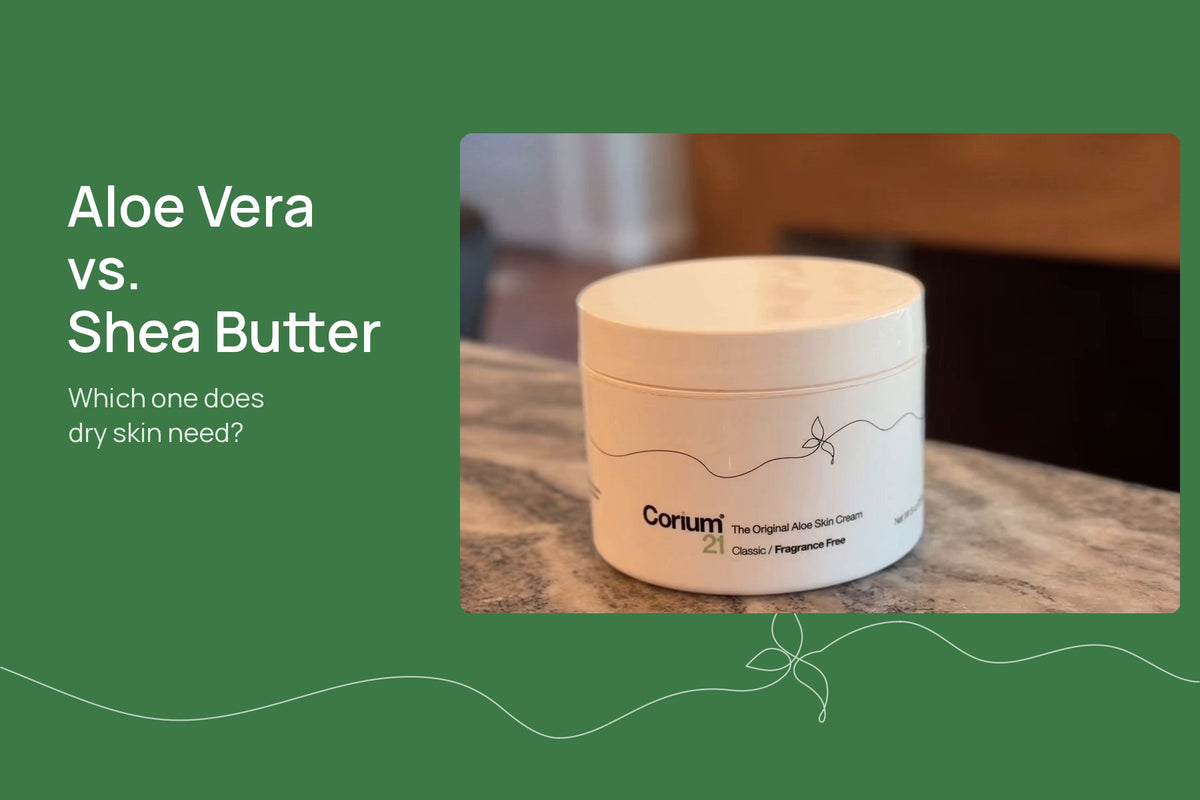
Corium 21's cream lists certified organic aloe vera as its first ingredient (see the full list). Corium 21 is a family-owned company that makes a moisturizing cream with certified organic aloe vera. Trusted since 1994. Family-owned in Oregon. It is a cosmetic moisturizer: it moisturizes and helps relieve dryness. It is not intended to diagnose, treat, cure, or prevent any disease.