
Last updated: October 2026
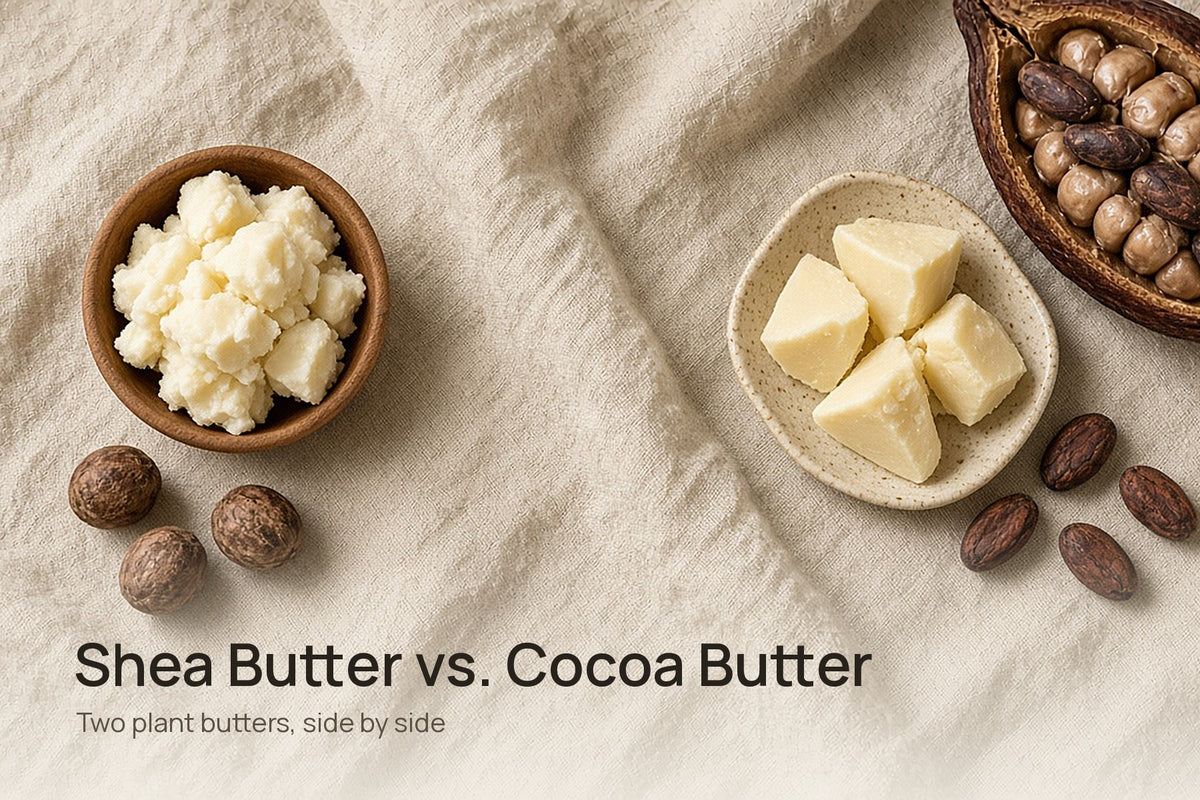
Short answer: Both are rich plant fats that soften dry skin. Shea butter is softer and easier to spread, and the American Academy of Dermatology lists it by name among ingredients to look for in a dry-skin cream. Cocoa butter is firmer: it's hard below about 25 °C and melts around 34 °C, which makes it popular in bars and balms. Cocoa butter's best-known claim, preventing stretch marks, didn't hold up in a randomized trial.
At a glance
| Shea butter | Cocoa butter | |
|---|---|---|
| Source | Nuts of the shea tree (Vitellaria paradoxa) | Cacao beans (Theobroma cacao) |
| Main fatty acids | Stearic 28–56% and oleic 34–61%, varying by region | About 27% palmitic, 36% stearic, 34% oleic |
| Texture | Soft and spreadable at room temperature | Hard below about 25 °C; melts near 34 °C |
| Scent (unrefined) | Mild, nutty | Chocolate-like |
| Named by the AAD for dry skin | Yes | No |
| On a label | Butyrospermum Parkii (Shea) Butter | Theobroma Cacao (Cocoa) Seed Butter |
What's in shea butter
Shea butter comes from the nuts of the shea tree, which grows across a belt of Africa. A study of shea from seven African countries found its fats are dominated by stearic (28–56%) and oleic (34–61%) acids. Shea is also unusually rich in the part of a fat that doesn't turn into soap: triterpene alcohols made up 22–72% of that fraction, and West African shea generally had more than East African shea.
In a small study of 34 children with eczema, a cream containing shea butter extract was acceptable to about three quarters of them and didn't differ in acceptability or efficacy from a product with building blocks skin uses to make its own ceramides (natural skin fats). The researchers didn't find a drop in eczema severity with either.
What's in cocoa butter
Cocoa butter is the fat pressed from cacao beans, the same fat that makes chocolate melt in your mouth. Its main fatty acids are palmitic (27%), stearic (36%) and oleic (34%). It's a hard fat below about 25 °C and softens in the hand, which is why it's used in solid lotion bars, lip balms and stick moisturizers.
Does cocoa butter prevent stretch marks?
The evidence says no. In a double-blind, placebo-controlled trial, 175 pregnant women used either a cocoa butter lotion or a placebo lotion. Stretch marks developed in 45.1% of the cocoa butter group and 48.8% of the placebo group, a difference that wasn't statistically significant. The authors concluded that cocoa butter does not appear to reduce the chance of developing them.
Which is better for dry skin?
Both are emollients: they soften and smooth skin and add a light protective layer. Neither seals in water as well as petrolatum (petroleum jelly), which can reduce water loss through the skin by more than 98%. So pick by texture. Shea is easier to use in a daily hand or body cream. Cocoa butter suits solid balms and bars. Many body butters use both.
Butters work best on skin that's still slightly damp, or on top of a water-based product that brings moisture with it.
How to find them on a label
Look for "Butyrospermum Parkii" or "Vitellaria Paradoxa" (shea) and "Theobroma Cacao Seed Butter" (cocoa). The higher they appear before the preservatives, the more of the product they likely make up. The Ingredient Label Decoder estimates a range for each ingredient above the 1% line.
Check your own moisturizer. Paste its ingredient list into our free Ingredient Label Decoder to find the likely 1% line, see a rough percentage for each ingredient, and learn what each one does.
Frequently asked questions
Is shea butter or cocoa butter better for dry skin?
Both soften dry skin. Shea butter is softer and easier to spread, and the American Academy of Dermatology lists it among ingredients to look for. Cocoa butter is firmer and suits balms and bars.
Does cocoa butter prevent stretch marks?
A randomized, placebo-controlled trial of 175 pregnant women found no meaningful difference: 45.1% of the cocoa butter group and 48.8% of the placebo group developed stretch marks.
Can you mix shea butter and cocoa butter?
Yes. Many body butters blend them: shea for softness and spreadability, cocoa butter for firmness.
More ingredient comparisons
- Aloe Vera vs. Shea Butter for Dry Skin: Which Do You Need?
- Aloe Vera vs. Coconut Oil for Dry Skin
- Lotion vs. Cream vs. Ointment: Which Is Best for Dry Skin?
- See all ingredient comparisons
Sources
- Akihisa T, Kojima N, Katoh N, et al. Triterpene Alcohol and Fatty Acid Composition of Shea Nuts from Seven African Countries. Journal of Oleo Science. 2010;59(7):351-360. https://www.jstage.jst.go.jp/article/jos/59/7/59_7_351/_article
- Hon KL, Tsang YC, Pong NH, et al. Patient acceptability, efficacy, and skin biophysiology of a cream and cleanser containing lipid complex with shea butter extract versus a ceramide product for eczema. Hong Kong Medical Journal. 2015;21(5):417-25. https://hkmj.org/abstracts/v21n5/417.htm
- Cisse V, Yemiscioglu F. Cacao Butter and Alternatives Production. Çukurova Journal of Agricultural and Food Sciences. 2019;34(1):37-50. https://dergipark.org.tr/en/download/article-file/765734
- Osman H, Usta IM, Rubeiz N, et al. Cocoa butter lotion for prevention of striae gravidarum: a double-blind, randomised and placebo-controlled trial. BJOG. 2008;115(9):1138-42. https://pubmed.ncbi.nlm.nih.gov/18715434/
- American Academy of Dermatology. Dermatologists' top tips for relieving dry skin. https://www.aad.org/public/everyday-care/skin-care-basics/dry/dermatologists-tips-relieve-dry-skin
- Purnamawati S, Indrastuti N, Danarti R, Saefudin T. The Role of Moisturizers in Addressing Various Kinds of Dermatitis: A Review. Clinical Medicine & Research. 2017;15(3-4):75-87. https://www.clinmedres.org/content/15/3-4/75
About this page
We wrote this comparison from the sources listed above and confirmed each figure on the linked page in October 2026. It is general information, not medical advice. If you have painful, cracked, bleeding or persistent skin problems, see a doctor or dermatologist.
Corium 21 is a family-owned company that makes a moisturizing cream with certified organic aloe vera. Trusted since 1994. Family-owned in Oregon. It is a cosmetic moisturizer: it moisturizes and helps relieve dryness. It is not intended to diagnose, treat, cure, or prevent any disease.