
Last updated: October 2026
Short answer: They aren't the same. Fragrance-free generally means no fragrance ingredients were added. Unscented means the product shouldn't smell like much, and that can be done by adding a masking fragrance. The FDA warns that even some products labeled "unscented" may contain fragrance ingredients. If you have sensitive or eczema-prone skin, dermatologists recommend products labeled "fragrance-free", and checking the ingredient list is the only sure way to know.
At a glance
| Fragrance-free | Unscented | |
|---|---|---|
| What it usually means | No fragrance ingredients added | No noticeable smell |
| Can it contain masking fragrance? | It shouldn't | Yes |
| May still smell like | Its raw ingredients (oils, butters, plant extracts) | Little or nothing |
| Best for sensitive skin | Yes, recommended by dermatologists | Check the label first |
| What to check on the label | No "Fragrance," "Parfum" or added essential oils | Look for "Fragrance," "Parfum" or "Masking fragrance" |
Why fragrance matters for skin
The FDA says that some components of fragrance formulas may cause allergic reactions or sensitivities in some people. Fragrance is hard to avoid by reading labels alone: in the U.S., fragrance ingredients can be listed simply as "Fragrance" or "Flavor," and the FDA notes it doesn't have the same authority to require allergen labeling for cosmetics as it does for food.
Fragrance allergy is common among people who get patch tested. In the North American Contact Dermatitis Group's 2021–2022 results from 3,056 patients at 12 centers, the authors wrote that fragrance allergy is still very common. Hydroperoxides of linalool, an oxidized form of a fragrance chemical found in many scented products, caused a positive reaction in 10.1% of patients tested.
What "unscented" can hide
Many raw ingredients have a smell of their own: fatty or waxy notes from oils, an earthy note from plant extracts. To make a product smell neutral, a manufacturer can add a small amount of fragrance that cancels those odors out. The product then smells of nothing and can be sold as "unscented," but it still contains fragrance.
The reverse also happens. A truly fragrance-free product may have a faint natural smell from its ingredients, and that's fine.
How to check an ingredient list
Ignore the front of the package and read the ingredients. Look for:
- "Fragrance," "Parfum," "Aroma" or "Flavor"
- Essential oils added for scent, such as Lavandula Angustifolia (Lavender) Oil or Citrus Aurantium Dulcis (Orange) Peel Oil
- Common fragrance chemicals such as Linalool, Limonene, Citronellol, Geraniol and Eugenol
The Ingredient Label Decoder flags fragrance and common fragrance components automatically and explains why people with sensitive skin watch for them.
Check your own moisturizer. Paste its ingredient list into our free Ingredient Label Decoder to find the likely 1% line, see a rough percentage for each ingredient, and learn what each one does.
Frequently asked questions
Is unscented the same as fragrance-free?
No. Fragrance-free generally means no fragrance ingredients were added. Unscented means the product has no noticeable smell, which can be achieved by adding a masking fragrance. The FDA notes that some products labeled unscented may contain fragrance ingredients.
Which is better for sensitive skin, fragrance-free or unscented?
Fragrance-free. Dermatologists recommend products labeled fragrance-free for dry and sensitive skin, and the ingredient list should not include fragrance, parfum or added essential oils.
Why doesn't the label list what's in the fragrance?
In the U.S., fragrance ingredients can be listed simply as "Fragrance" because fragrance formulas are often treated as trade secrets.
More ingredient comparisons
- Lotion vs. Cream vs. Ointment: Which Is Best for Dry Skin?
- Ceramides vs. Hyaluronic Acid: What's the Difference?
- Aloe Vera vs. Shea Butter for Dry Skin: Which Do You Need?
- See all ingredient comparisons
Sources
- U.S. Food and Drug Administration. Fragrances in Cosmetics. https://www.fda.gov/cosmetics/cosmetic-ingredients/fragrances-cosmetics
- American Academy of Dermatology. Dermatologists' top tips for relieving dry skin. https://www.aad.org/public/everyday-care/skin-care-basics/dry/dermatologists-tips-relieve-dry-skin
- Houle M-C, DeKoven JG, Atwater AR, et al. North American Contact Dermatitis Group Patch Test Results: 2021-2022. Dermatitis. 2025. https://hsrc.himmelfarb.gwu.edu/gwhpubs/6995
About this page
We wrote this comparison from the sources listed above and confirmed each figure on the linked page in October 2026. It is general information, not medical advice. If you have painful, cracked, bleeding or persistent skin problems, see a doctor or dermatologist.
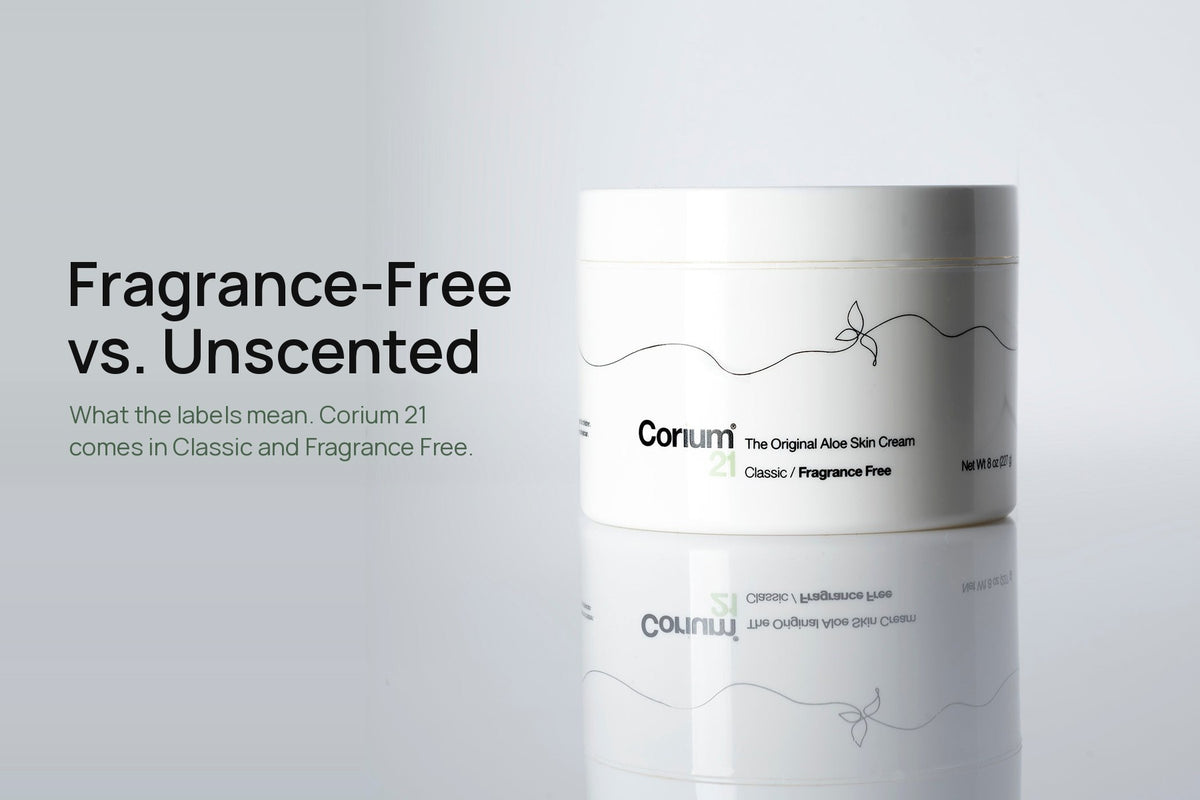
Corium 21 comes in two versions: Classic Fragrance and Fragrance Free, which is the same formula without the fragrance (see the ingredient list). Corium 21 is a family-owned company that makes a moisturizing cream with certified organic aloe vera. Trusted since 1994. Family-owned in Oregon. It is a cosmetic moisturizer: it moisturizes and helps relieve dryness. It is not intended to diagnose, treat, cure, or prevent any disease.