
Last updated: October 2026
Short answer: An organic aloe vera moisturizer is a cream or lotion made with aloe grown under organic rules. On a US label the word means different things: only products that are at least 95% organic (not counting water and salt) can carry the USDA Organic seal, and products under 70% can only name their organic ingredients in the ingredient list. To find aloe-first creams, check the first line of the ingredient list for "Aloe Barbadensis Leaf Juice." Corium 21 lists certified organic aloe vera as its first ingredient, ahead of water.
How can you tell if aloe is the main ingredient?
US cosmetic labels list ingredients in descending order of predominance, so whatever is first is present in the largest amount. Ingredients at 1% or less can be listed in any order after that, which is why chemists read a label from the top down (here's how one cosmetic chemist does it).
- Aloe Barbadensis Leaf Juice near the top means aloe juice is a main part of the base.
- Aloe Barbadensis Leaf Juice Powder is dried aloe. It is often used in small amounts and mixed back into water, so it tends to sit lower on the list.
- "Drug Facts" labels (skin protectants such as many ointments) list the inactive ingredients alphabetically, so an ingredient's position there tells you nothing about how much is in the jar.
Want to check a specific label? Paste it into our free Ingredient Label Decoder. It finds the likely 1% line, estimates a rough percentage for each ingredient and explains what each one does.
Why is water the first ingredient in so many aloe products?
Most lotions and creams are water-based, and aloe gel itself is about 99.5% water. When a product lists water first, aloe is one ingredient among many. When aloe juice is listed first, it takes the place of plain water as the base of the formula.
What does "certified organic" mean for skin care?
The FDA does not define "organic" for cosmetics. The USDA's National Organic Program covers products made from agricultural ingredients, and its fact sheet for cosmetics sets four label tiers:
| Label tier | Organic content (not counting water and salt) | USDA seal allowed? |
|---|---|---|
| "100% organic" | Only organic ingredients | Yes |
| "Organic" | At least 95% | Yes |
| "Made with organic ..." | At least 70% | No, but the front can name up to three organic ingredients |
| Less than 70% | Some organic ingredients | No. Organic ingredients can only be named in the ingredient list |
So a cream can be made with a certified organic ingredient, such as aloe, without the whole product carrying the USDA seal. That is common in creams, because the water, emulsifiers (ingredients that keep oil and water mixed) and preservatives that hold a cream together are usually not farm-grown ingredients.
Inner leaf vs whole leaf aloe: what's the difference?
According to the International Aloe Science Council, inner leaf aloe is made by removing the rind and grinding the clear gel inside. Whole leaf aloe is made by grinding the entire leaf, then filtering it, usually through charcoal, to remove aloin, a compound in the yellow latex under the rind. For products applied to the skin, the Cosmetic Ingredient Review (an expert panel that reviews the safety of cosmetic ingredients) set a limit of 50 ppm (parts per million) aloin.
How do you tell if an aloe cream has real aloe?
The IASC uses acemannan, a sugar found in aloe, as the marker of real aloe vera, and runs a certification program with facility inspections and lab testing. Its advice: look for the seal and confirm the company on the certified products list, because a seal alone can be copied. Otherwise, the ingredient list is your best guide: aloe juice near the top, not just aloe powder near the bottom.
Where does Corium 21 fit?
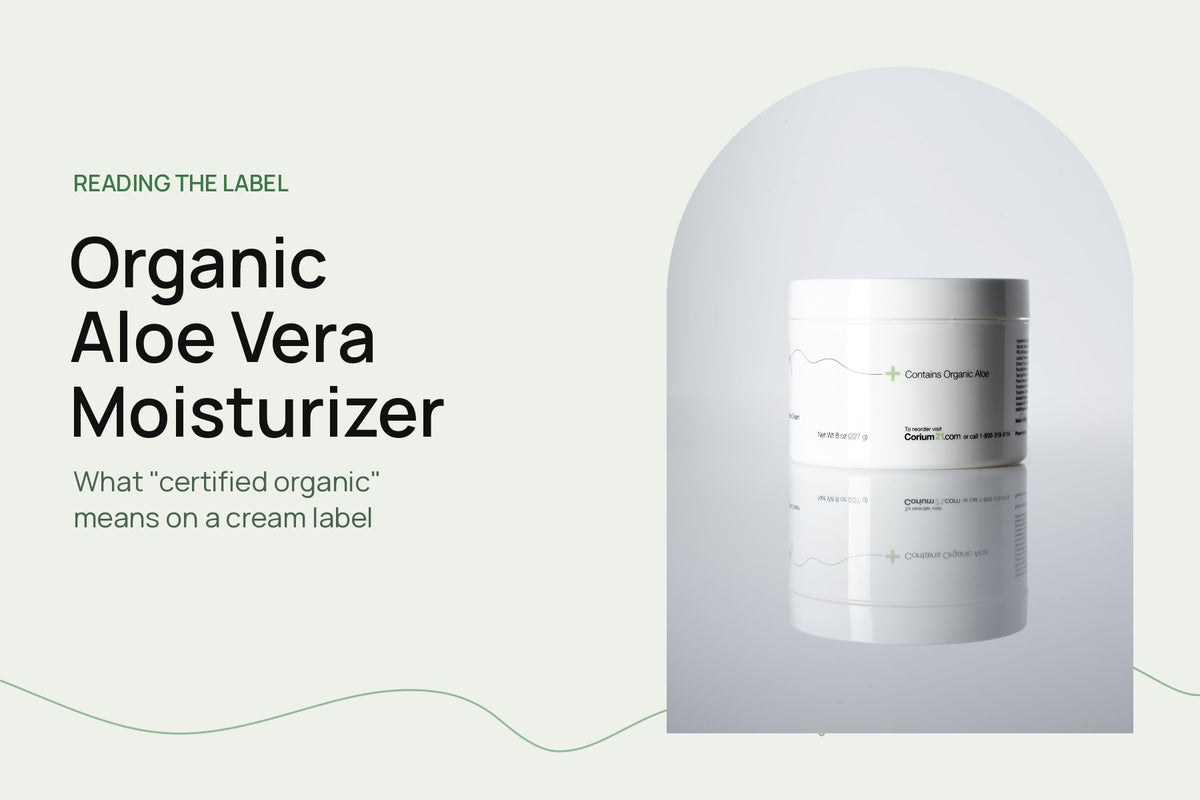
Corium 21 is an aloe vera skin cream for dry skin. The first ingredient is Aloe Barbadensis Leaf Juice (Organic), certified organic aloe vera, listed ahead of water. The rest of the formula includes glycerin, soluble collagen, niacinamide (vitamin B3), vitamins A, C, D3 and E, rose hip oil, allantoin, and green tea, chamomile, ginseng and comfrey extracts. The organic claim is about the aloe; the finished cream is not sold as a USDA Organic product. It is a cream, not a gel, so it moisturizes like a cream while leading with aloe.
It comes in Classic Fragrance and Fragrance Free (the same formula with the fragrance left out), in an 8 oz jar, a 32 oz quart with pump and a gallon with pump. Trusted since 1994. Family-owned in Oregon. Not sure yet? Free Samples are two 0.5 oz jars, one Classic and one Fragrance Free, for $3.95 shipping (one per customer). Full sizes come with our 90-day promise: if it isn't right for you, email support@corium21.com within 90 days for a refund of the product price, even if the jar is opened. Questions? Call (800) 319-5114 and talk to a real person.
Curious how aloe compares with other moisturizing ingredients? See our ingredient comparisons, including aloe vera vs shea butter and aloe vera vs coconut oil.
Questions people ask
What is the best organic aloe vera moisturizer?
Look for organic aloe juice listed first on the ingredient list, a cream rather than a gel if your skin is dry, and a clear, complete ingredient list. Corium 21 is one option: certified organic aloe vera is its first ingredient, ahead of water, and it comes in Classic and Fragrance Free.
Is Corium 21 organic?
Corium 21 is made with certified organic aloe vera, which is its first ingredient. The organic claim applies to the aloe; the finished cream is not sold as a USDA Organic product.
Why is water the first ingredient in most aloe products?
Most creams and lotions are water-based, so water is usually the largest ingredient. Aloe gel itself is about 99.5% water. When aloe juice is listed first, it replaces plain water as the base.
Is inner leaf aloe better than whole leaf aloe?
Both can be used in skin care. Inner leaf aloe comes from the clear gel; whole leaf aloe is ground from the full leaf and filtered to remove aloin. What matters most is that the product contains real aloe and the aloin is removed.
Is organic aloe better for skin than regular aloe?
There is no good evidence that organic aloe moisturizes better. "Organic" describes how the plant was grown and handled, not how well a cream works.
How do I check how much aloe is in a cream?
Brands rarely publish exact amounts, but the order of the ingredient list gives a clue. Paste the list into the free Ingredient Label Decoder for a rough estimate.
Sources
- USDA Agricultural Marketing Service. Cosmetics, Body Care Products, and Personal Care Products (National Organic Program fact sheet). https://www.ams.usda.gov/sites/default/files/media/OrganicCosmeticsFactSheet.pdf
- International Aloe Science Council. Aloe FAQs. https://www.iasc.org/aloe_faqs
- Hamman JH. Composition and Applications of Aloe vera Leaf Gel. Molecules. 2008;13(8):1599-1616. https://www.mdpi.com/1420-3049/13/8/1599/htm
- Code of Federal Regulations, 21 CFR 701.3, Designation of ingredients. https://www.govinfo.gov/content/pkg/CFR-1996-title21-vol7/html/CFR-1996-title21-vol7-sec701-3.htm
- Chemists Corner. How to analyze a cosmetic ingredient list. https://chemistscorner.com/how-to-analyze-a-cosmetic-ingredient-list/
About this page
Corium 21 is a family-owned company that makes a moisturizing cream with certified organic aloe vera. Trusted since 1994. Family-owned in Oregon. Certified organic aloe vera is the cream's first ingredient (see the full list). It is a cosmetic moisturizer: it moisturizes and helps relieve dryness. It is not intended to diagnose, treat, cure, or prevent any disease. This page is general information, not medical advice. If your skin is cracked and bleeding, painful, or not getting better, see a doctor or dermatologist.